<-- Icons -->
  • People
  • Research
  • Projects
  • Publications
  • Resources
ViCoS Lab

DIVID
Detection of inconsistencies in complex visual data using deep learning

basic research project
July 2018 - December 2021

Collaborating partners

  • University of Ljubljana, Faculty of Computer and Information Science
  • UL, Faculty of Electrical Engineering

Funding

  • ARRS (J2-9433)

Researchers

Danijel Skočaj, PhD
Danijel Skočaj, PhD
Domen Tabernik, PhD
Domen Tabernik, PhD
Matej Kristan, PhD
Matej Kristan, PhD
Jon Muhovič, MSc
Jon Muhovič, MSc
Vitjan Zavrtanik, PhD
Aleš Leonardis, PhD
Aleš Leonardis, PhD

Project overview

Obtaining a large amount of visual data has become a trivial task in today’s technological world. However, making use of this enormous amount of data poses a huge challenge. Computer vision and machine learning, in particular deep learning, offer answers to these requirements, however most of the approaches proposed rely on labelled training data; they therefore still require a significant human effort for labelling the required amounts of data, which is very costly, tedious and sometimes error-prone or even impossible. In this project we will address this issue for a particular computer vision task of anomaly detection in images. Our aim is to go beyond the traditional supervised learning, where all anomalies on all training images have to be adequately labelled. The objective of the proposed project is to develop novel deep learning methods for modelling complex consistency and detecting inconsistencies in visual data using training images annotated with different levels of accuracy. We will validate the developed methods in three related but different problem domains; visual inspection, remote sensing, and visual surveillance.

The expected contributions of the project are therefore:

  • weakly-supervised method for detection and segmentation of anomalies in visual data,
  • semi-supervised and self-supervised methods for anomaly detection,
  • methods for deep generative modelling of visual consistency for anomaly detection,
  • application of anomaly detection methods to visual inspection, remote sensing, and visual surveillance problem domains.

Workpackages: The work programme will be divided into seven work packages. Research will be conducted in the first five work packages that will address the following objectives of the project:

  • Development of (weakly) supervised approaches for anomaly detection (WP1).
  • Development of novel semi- and self-supervised learning of data consistency for anomaly detection (WP2).
  • Development of deep generative compositional models for anomaly detection (WP3).
  • Guiding the learning process by considering the cognitive relevance of the learned models (WP4).
  • Adaptation of developed data consistency learning for anomaly detection to three problem domains: (i) visual inspection, (ii) remote sensing, and (iii) visual surveillance (WP5).
  • The remaining two work packages relate to the dissemination of the results (WP6) and project management (WP7).

Project phases:

  • Year 1: Activities on work packages WP1, WP2, WP4, WP5, WP6, WP7
  • Year 2: Activities on work packages WP2, WP3, WP4, WP5, WP6, WP7
  • Year 3: Activities on work packages WP3, WP4, WP5, WP6, WP7

Results
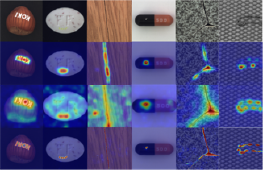
Visual anomaly detection

This research focuses on the development of unsupervised visual anomaly detection methods. Trained on anomaly-free samples only, these methods attempt to remove the need for a difficult acquisition of a diverse set of anomalous objects while aiming to match the performance of supervised methods.

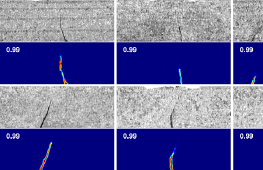
Industrial surface defect detection

The developed methods allow specialization for large defect detection on various indistrual items such as cracks, smudges, imperfections etc. The methods are learning-based and are thus robust, run realtime and are applicable to a wide range of real problems.

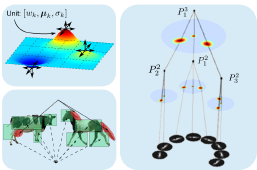
Deep structured models

Contains 4 subtopics
This research is dedicated to deep models which utilize compositional structure of object parts. The methodologies span from modern deep learning frameworks to more classical hierarchies of parts.

Publications

  •  
    Dense Center-Direction Regression for Object Counting and Localization with Point Supervision
    Domen Tabernik, Jon Muhovič and Danijel Skočaj
    Pattern Recognition, 2024
  •  
    Automated detection and segmentation of cracks in concrete surfaces using joined segmentation and classification deep neural network
    Domen Tabernik, Matic Šuc and Danijel Skočaj
    Construction and Building Materials, 2023
  •  
    Video-Based Ski Jump Style Scoring from Pose Trajectory
    Dejan Štepec and Danijel Skočaj
    IEEE/CVF Winter Conference on Applications of Computer Vision Workshops (WACVW), 2022
  •  
    Analiza robustnosti globokih nenadzorovanih metod za detekcijo vizualnih anomalij
    Jakob Božič, Vitjan Zavrtanik and Danijel Skočaj
    ERK, 2021
  •  
    DRAEM -- A discriminatively trained reconstruction embedding for surface anomaly detection
    Vitjan Zavrtanik, Matej Kristan and Danijel Skočaj
    ICCV 2021, 2021
  • Fully supervised and point-supervised ship detection using center prediction, LUVSS-2021-11
    Domen Tabernik, Jon Muhovič and Danijel Skočaj
    Technical Report, 2021
  •  
    Mixed supervision for surface-defect detection: from weakly to fully supervised learning
    Jakob Božič, Domen Tabernik and Danijel Skočaj
    Computers in Industry, Elsevier, 2021
  •  
    Reconstruction by inpainting for visual anomaly detection
    Vitjan Zavrtanik, Matej Kristan and Danijel Skočaj
    Pattern Recognition, Elsevier, 2021
  •  
    A segmentation-based approach for polyp counting in the wild
    Vitjan Zavrtanik, Martin Vodopivec and Matej Kristan
    Engineering Applications of Artificial Intelligence, Elsevier, 2020
  •  
    End-to-end training of a two-stage neural network for defect detection
    Jakob Božič, Domen Tabernik and Danijel Skočaj
    ICPR, 2020
  •  
    O klasifikaciji slik v ne-enolično določljive razrede
    Jon Muhovič, Domen Tabernik and Danijel Skočaj
    ERK, 2020
  •  
    Segmentation-Based Deep-Learning Approach for Surface-Defect Detection
    Domen Tabernik, Samo Šela, Jure Skvarč and Danijel Skočaj
    Journal of Intelligent Manufacturing, 2020
  •  
    Spatially-Adaptive Filter Units for Compact and Efficient Deep Neural Networks
    Domen Tabernik, Matej Kristan and Aleš Leonardis
    International Journal of Computer Vision, 2020
  •  
    Deep Learning for Large-Scale Traffic-Sign Detection and Recognition
    Domen Tabernik and Danijel Skočaj
    Transactions on Intelligent Transportation Systems, IEEE, 2019
  •  
    Deep-learning-based computer vision system for surface-defect detection
    Domen Tabernik, Samo Šela, Jure Skvarč and Danijel Skočaj
    Proceedings of the 12th International Conference on Computer Vision Systems, 2019

Financer

ARRS, Slovenian Research Agency

arrs

Faculty of Computer and Information Science

Visual Cognitive Systems Laboratory

University of Ljubljana

Faculty of Computer and Information Science

Večna pot 113
SI-1000 Ljubljana
Slovenia
Tel.: +386 1 479 8245